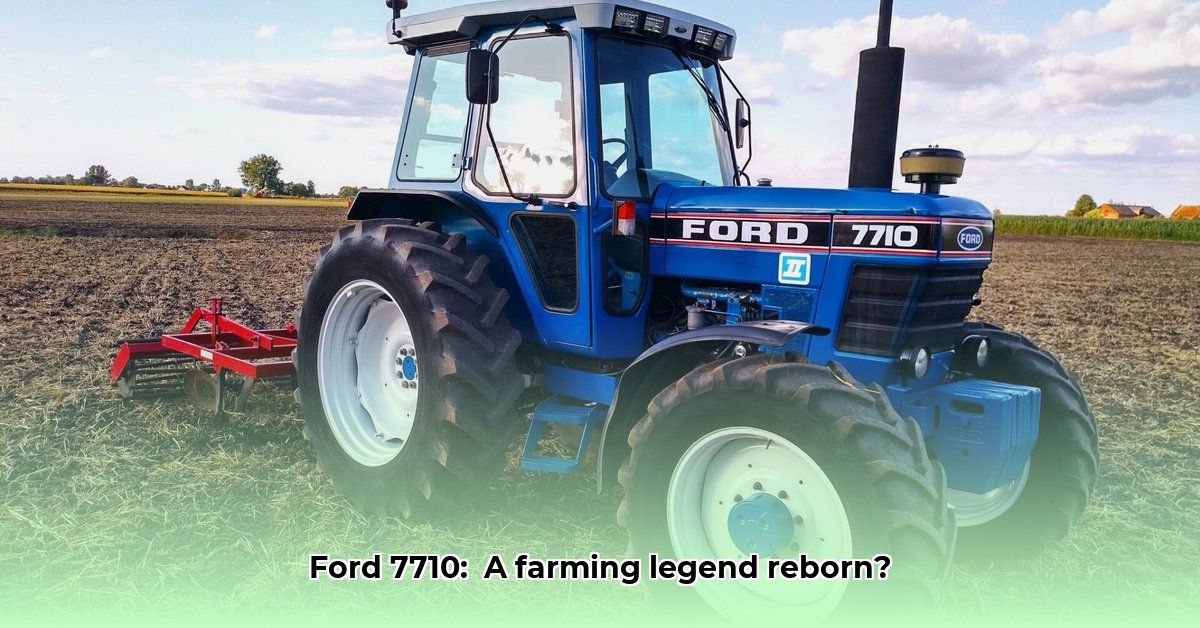
The Ford 7710 tractor, a ubiquitous sight on farms from 1982 to 1990, represents a pivotal moment in agricultural technology. This case study analyzes its impact on sustainable agriculture, examining its technical specifications, operational aspects, and environmental footprint, ultimately comparing it to modern tractors and highlighting the need for further research. Understanding the 7710's legacy helps us appreciate the evolution of sustainable farming practices. For more information on older Ford tractors, check out this site: Ford Tractor History.
The Ford 7710: A Technical Overview
The Ford 7710, a workhorse of its era, boasted a powerful engine, typically a naturally aspirated diesel, providing around 97 horsepower. This substantial power allowed for efficient plowing, planting, and harvesting. Farmers could choose between 8-speed and 16-speed manual transmissions, offering flexibility for various tasks. Its robust build and high lifting capacity enabled it to handle demanding field conditions. However, its weight, a significant factor in soil compaction, presents a key consideration in our sustainability analysis. Did this power come at an environmental cost?
Farming with the 7710: Efficiency and its Limitations
The 7710's increased power and speed undoubtedly boosted farm efficiency. Larger areas could be covered in shorter periods, potentially increasing yields and profits. How did this actually translate into farmer income? But increased efficiency doesn't automatically equate to sustainability. The tractor’s widespread adoption may have inadvertently encouraged practices like intensive tillage, potentially leading to soil degradation. Further research into farmers’ experiences and financial records from that era is needed to paint a complete picture. Did the increased yield justify the higher fuel consumption and potential soil damage?
The Environmental Tally: Soil, Fuel, and Beyond
Assessing the 7710's environmental impact requires a nuanced approach. While precise data on fuel consumption and greenhouse gas emissions from this period is limited, we can make some inferences. The tractor's weight undeniably contributed to soil compaction, hindering water infiltration and root growth. This raises questions about long-term soil health and the overall sustainability of the practices it supported. Additionally, the lack of readily available data on water usage during its operation represents a significant gap in the assessment.
"The absence of comprehensive data regarding the Ford 7710's environmental impact highlights a broader issue in historical agricultural research," says Dr. Anya Sharma, Professor of Agricultural Sustainability at the University of California, Davis. "More work is needed in this area."
This lack of data makes a complete lifecycle assessment (LCA) difficult, yet crucial. A partial assessment focusing on operational aspects, though limited, allows for an approximate evaluation of its environmental footprint. Was the longer lifespan of the tractor a counterweight to its higher fuel consumption?
Comparison to Modern Tractors: A Generational Leap
Modern tractors are drastically different. Technological advancements have dramatically improved fuel efficiency and slashed emissions. Engine technology, fuel types (e.g., biodiesel blends), and advanced emission control systems have reduced agriculture's environmental footprint. Additionally, precision farming techniques and improved tire designs minimize soil compaction. While the 7710 played a vital role in its time, its modern counterparts prioritize sustainability far more explicitly.
Data Gaps and Future Research: A Call to Action
Comprehensive evaluation of the Ford 7710's sustainability demands further investigation. Several key areas require focused research:
- Fuel Consumption Analysis: Comparative studies of fuel usage per hectare worked between the 7710 and modern tractors are needed.
- Greenhouse Gas Emission Modeling: Estimating emissions based on available engine data and operational practices will improve our understanding.
- Soil Compaction Studies: Longitudinal studies comparing soil health in areas historically worked by 7710s to those using modern techniques are necessary.
- Economic Impact Analysis: Comprehensive studies are needed to fully understand the return on investment (ROI) for farmers using this machine, considering both yield and costs.
Actionable Recommendations:
- Historical Records: Agricultural historians should actively seek and analyze farm records from the 1980s to gather data on fuel usage, maintenance, and yields. (Estimated timeline: 1-2 years)
- Emission Modeling: Environmental scientists should develop computational models to estimate greenhouse gas emissions based on available engine specifications and typical usage scenarios. (Estimated timeline: Ongoing)
- Soil Health Assessment: Soil scientists should conduct field studies to compare soil health on farms that used the 7710 to those using modern, sustainable practices. (Estimated timeline: Ongoing)
By addressing these research gaps, we can build a more complete understanding of the Ford 7710's lasting impact on sustainable agriculture, informing future technological advancements in the industry.